



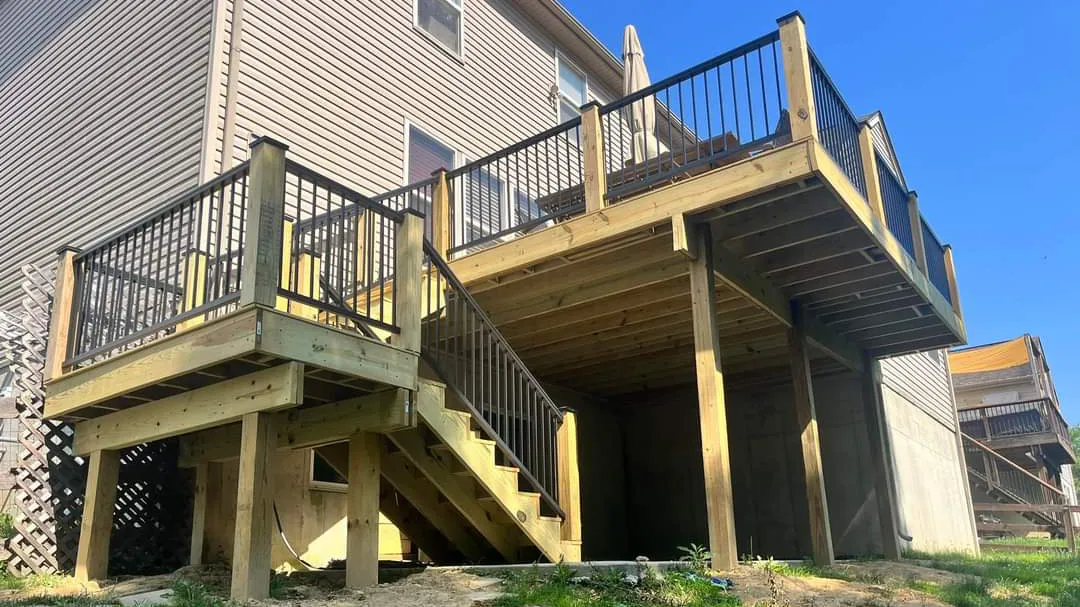
Ask ten homeowners what they look at when evaluating a deck and you’ll hear about the decking color, the railing style, the size, maybe the stairs. Ask ten builders what they look at and you’ll get a completely different answer. The first thing experienced builders examine is where the deck meets the house, specifically the ledger board and how it’s attached.
That single connection point is responsible for more catastrophic deck failures than any other component, by a wide margin. When decks collapse (and they do, more often than most people realize), the failure almost always traces back to the ledger. Not the joists, not the posts, not the railings. The ledger.
This isn’t a theoretical concern. It’s the single most important detail in custom deck framing, and it’s also the detail that’s easiest to get wrong in ways that don’t show up for years until something goes badly wrong.
Here’s what every Huntingtown homeowner should understand about ledger board attachment, why it matters so much, and what separates a proper installation from one that’s quietly waiting to fail.
What a Ledger Board Actually Is
The ledger board is the horizontal piece of framing lumber attached to your house that supports one entire side of your deck. The deck’s joists hang off it on one end and rest on beams and posts on the other end. Everything that sits on the deck (the boards, the railing, the furniture, the people, the snow, the hot tub) puts load on that ledger.
When a deck is properly designed, the ledger and the outer beam share that load roughly equally. When a deck fails at the ledger, the entire structure rotates away from the house and falls. There’s no graceful failure mode. It’s catastrophic, sudden, and usually happens when the deck is loaded with people, which is exactly when failures cause the most harm.
This is why ledger attachment is treated as the single highest-risk detail in any custom deck framing project.
Why Ledger Failures Happen
Three things cause ledger failures, alone or in combination
Inadequate fasteners Nails fail. They don’t have the shear strength for deck loads, and they pull out over time as wood shrinks and swells through Maryland’s seasons. Yet a surprising number of older decks (and some newer ones built by less careful contractors) are still attached with nails or with too few lag bolts spaced too far apart
Improper flashing Water that gets between the ledger and the house has nowhere to go. It sits, it soaks into the band joist of your house, and it rots both the ledger and the structural wood of your home itself. By the time you see staining inside, the damage has been progressing invisibly for years. Rotted wood holds fasteners poorly. Eventually the connection fails
Attachment to the wrong substrate A ledger has to bolt into solid structural framing inside the house. If it’s bolted into siding, sheathing, or veneer instead of the actual band joist or wall framing, it has no real strength regardless of how many bolts are used. Brick and stone veneer is a particularly common problem because it looks solid but isn’t structural
Each of these failure modes is preventable with proper design and installation. None of them are obvious from the surface. That’s what makes ledger work so important and so easy to skip corners on.
What Proper Ledger Attachment Looks Like
A correctly installed ledger involves several layers of detail, each one critical
Structural lag screws or through-bolts at engineered spacing Modern code requires specific fastener types at specific intervals based on deck size and load. The exact pattern depends on the project, but the era of a few lag bolts every couple feet is long over. Real engineering goes into fastener selection and placement for any custom deck framing project
Proper substrate connection The fasteners have to penetrate into the actual structural framing of the house, which means knowing exactly what’s behind the siding before drilling. On homes with brick veneer or other non-structural exteriors, this often requires significantly more work to reach a sound attachment point, sometimes including a structural standoff system that bridges the veneer
Continuous flashing Metal flashing tucked behind the siding above the ledger, extending down over the top of the ledger, and integrated with the wall’s water management system. This is the detail that prevents water from sitting against the ledger and rotting both it and your house. Good flashing is multi-layered, properly lapped, and made of materials rated for long-term outdoor exposure. Cheap flashing is a single piece of aluminum that fails within a few years
Drainage gap or rain screen Some modern installations include a small standoff between the ledger and the house that allows any water that does get behind the flashing to drain out rather than sit. This is becoming more common in higher-end custom deck framing and meaningfully extends the life of the connection
Lateral load connectors Building codes now require lateral load connectors on most new deck construction. These are hardware pieces that tie the deck framing back into the house’s framing in addition to the ledger itself. They exist specifically because so many decks have failed at the ledger, and they provide a redundant connection that prevents catastrophic collapse even if the primary ledger attachment fails
Why This Matters More in Huntingtown Than People Realize
A few factors make ledger attachment particularly critical for homes in Huntingtown and the surrounding Calvert County area
Humidity and moisture Maryland summers are humid, and homes near the Chesapeake Bay deal with sustained moisture exposure that accelerates rot in any wood that stays wet. A ledger with marginal flashing in this climate will fail faster than the same installation in Arizona
Freeze-thaw cycles Huntingtown winters bring multiple freeze-thaw cycles every year. Water that gets into a wood connection expands when it freezes and pushes the fibers apart. Over time, this destroys wood from the inside out. Decks built decades ago when flashing standards were lower often show advanced rot at the ledger today
Tree cover and shade Many Huntingtown properties have mature tree canopy, which is beautiful but means decks stay damper longer after rain. Wet wood doesn’t dry as quickly under heavy tree cover, and ledger connections in shaded areas need even more attention to drainage and flashing detail
Older housing stock Some homes in the area predate modern deck attachment standards by decades. If you’ve inherited an older deck (or you’re planning to attach a new deck to a home built before the late 2000s), the existing structural framing of the house may need to be inspected and sometimes reinforced before a new ledger can be safely installed
What to Look For When Evaluating Existing Decks
If you have an existing deck on your home, a few visible signs suggest the ledger deserves a closer look
- Water staining or discoloration on the siding or exterior wall above or below the ledger
- Visible rust streaks running down from the deck attachment area
- Any softness or visible damage to the ledger board itself
- Gaps between the ledger and the house, or evidence that the deck has pulled away even slightly
- A deck that bounces or moves perceptibly when people walk on it near the house
- No visible flashing where the deck meets the siding
- Nails (rather than lag bolts or through-bolts) visible in the ledger
- Attachment through brick or stone veneer without visible reinforcement hardware
None of these necessarily mean immediate danger, but all of them warrant a professional evaluation. Ledger failures don’t give much warning, so erring on the side of inspection is always the right call
The Honest Truth About Cost
Doing the ledger right takes longer and costs more than doing it quickly. There’s no way around that. Proper substrate inspection, quality flashing, correct fasteners, lateral load connectors, and the time to integrate it all with the existing house add real labor and material cost compared to a shortcut installation
The trade-off is straightforward. A properly installed ledger lasts as long as the deck itself, protects your home from water damage, and never fails catastrophically. A poorly installed one fails. Sometimes in five years, sometimes in twenty, but it fails. And when it does, the cost of the failure (in repairs, in damage to the house, and potentially in injuries) dwarfs whatever was saved on the original installation
For any custom deck framing project, this is the single detail where corners should never be cut
Ready to Build a Deck That Starts With the Right Foundation?
The ledger is invisible once the deck is finished, but it’s the difference between a structure that lasts decades and one that’s quietly counting down to failure. Getting it right requires experience, attention to detail, and a willingness to spend the time on the part of the build that nobody will ever see
Park Place Construction approaches every custom deck framing project with ledger attachment as a detail, because the rest of the deck only matters if the connection to your house is built to outlast it. Call us at +1 443-968-2327 to talk through your project and the structural details that separate a deck built right from one built fast
What to Ask a Builder About Ledger Attachment
If you’re planning a new deck or replacing an existing one, a few questions will reveal whether your builder takes ledger work seriously
How do you confirm what's behind the siding before installing the ledger?
The answer should reference specific inspection methods, not assumptions about typical construction
What flashing system do you use and how is it integrated with the existing wall water management?
Vague answers are red flags. Specific, multi-component answers are reassuring
How do you handle ledger attachment on homes with brick or stone veneer?
This is a specialized situation and the answer should reflect that. Builders who treat it as routine often don’t do it correctly
Are you including lateral load connectors and how are they specified for my project?
These should be standard on any new build. If a builder seems unfamiliar with them or treats them as optional, that’s a problem
Can you show me how the ledger flashing detail will be constructed?
Good builders can sketch it on the spot or show you photos from previous projects. The detail should be specific, multi-layered, and clearly thought through